
The structure of the WARM-M2M project is given hereafter
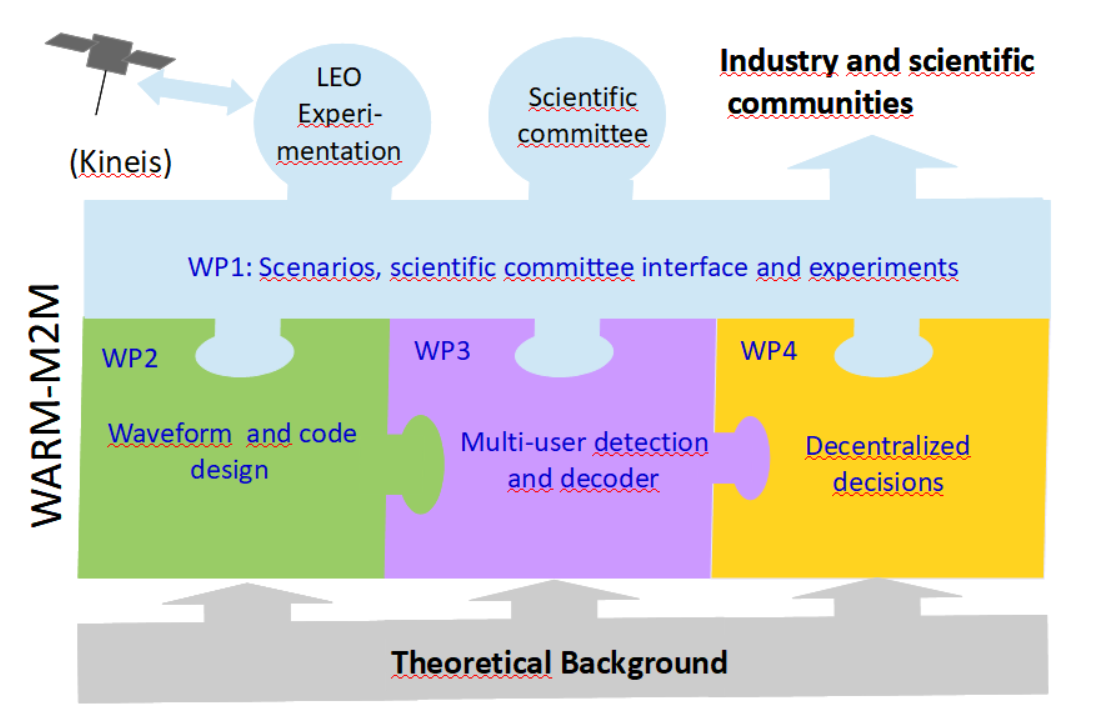
WP1 (Scenarios, scientific committee interface and experiments): This WP deals with the scientific management of the project. In particular, WP1 will organize the two scheduled meeting with a scientific committee composed of academic experts in the field, representative of two space agencies and also, directors of normalization department of companies. It will also define the real test of transmission scheduled with the help of KINEIS, a French Satcom company.
WP2 (Waveform and code design) The objective of WP2 is to build a frame with joint code design/waveform design that contains intrinsic properties to help synchronization (and thus, minimizing overhead) and multi-user (MU) detection. We intend to capitalize on the approaches developed by two members of the consortium (QCSP frame and Multi-linear spreading) to leverage existing results on those two technics, and extend them through a thorough analysis in the delay-Doppler domain.
WP3 (Multi-user detection and decoding) The objective of WP3 is to tackle the problem of Multi-User detection. The ambition is to go further than standard Multi-User successive interference cancellation by extending state-of-the-art techniques from a synchronous receiver to an asynchronous one. In particular, WP3 will develop a message passing algorithms (MPA) tailored to the specific waveforms and codes developed within the project, and adapt it to account for impairments due to Non-Terrestrial-Network channels. It will also explore how a MPA may be optimized with graph neural networks (GNNs). Finally, WP3 will extend MPA to a decentralized system where the signals are received by multiple base stations, radio heads or satellites, at different locations.
WP4 (Decentralized decisions): The objective of WP4 is to defined decentralized decision policy of the whole NTN system in a context where feedback is a scare resource. It will elaborate solutions to efficiently encode and transmit feedback from the C-RAN to the transmitters. It will also study decentralized learning solutions to perform resource allocation to the transmitters.